Business Outlook 2027 - Navigating Growth, Uncertainty, and Business Risks in Indonesia
Indonesia's economic outlook for 2027 presents a combination of opportunities and challenges for businesses. While economic growth is expected to remain resilient, mounting external pressures, currency volatility, uneven consumer spending, and shifting investment patterns are creating a more complex business environment.
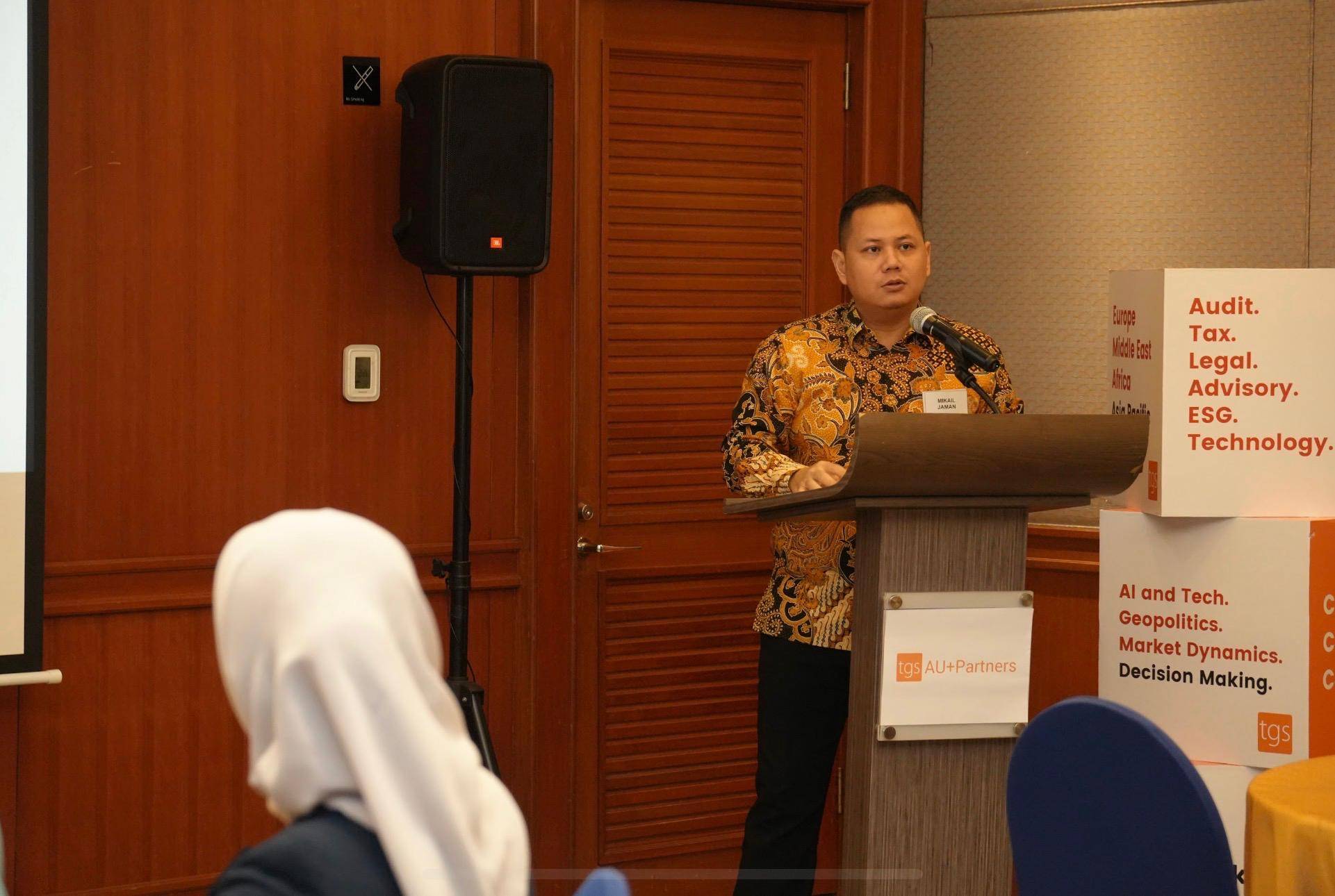
On Business Outlook 2027, Bapak Mikail Jaman— Managing Partner at KAP Agus Ubaidillah & Rekan (TGS AU Partners)— highlighted how these developments are essential for business leaders in making strategic decisions about budgeting, expansion, pricing, financing, and risk management.
A More Cautious Economic Outlook for 2027
Indonesia's economic growth remains relatively stable, although projections for 2027 vary among policymakers and independent analysts.
The Government has set an economic growth target of 6.0% in the 2027 State Budget Draft (RAPBN 2027), reflecting its ambition to accelerate economic development. Bank Indonesia projects growth at 5.1%–5.9%, with a midpoint of 5.5%, while Danamon estimates 5.1% and the OECD projects 5.0%.
These differing projections highlight the importance of adopting realistic assumptions when planning business operations. Indonesia's economic growth also moderated from 5.61% in the first quarter of 2026 to 5.29% in the second quarter, indicating that maintaining growth momentum may become increasingly challenging.
External developments add another layer of uncertainty. Geopolitical tensions in the Middle East continue to create risks for global energy supply and commodity prices. Meanwhile, changes in United States trade policies, including additional tariffs affecting Indonesian exports, have increased uncertainty for export-oriented industries.
Fitch and Moody's have also revised Indonesia's sovereign credit rating outlook to negative, reflecting concerns over fiscal constraints and the government's ability to maintain fiscal flexibility.
For businesses, these developments suggest that 2027 may not be a year of straightforward economic normalization. A more cautious approach to forecasting and financial planning will be essential.
Financial Conditions: Higher for Longer
Financial conditions are another important consideration for businesses entering 2027, particularly in terms of borrowing costs, currency exposure, and purchasing power.
Bank Indonesia maintained its policy rate at 5.75% in August 2026, following an increase from its earlier level of 4.75% in February 2026. The adjustment reflected inflationary pressures, particularly from food prices, as well as the Federal Reserve's relatively hawkish monetary policy stance.
Although gradual interest rate reductions may become possible in early 2027, they remain conditional on rupiah stability and controlled inflation. The Government's 2027 budget assumption also places the 10-year government bond yield at 6.9%, suggesting that financing costs may remain elevated.
Currency movements require similar attention. The Government and Bank Indonesia have set an exchange rate assumption of Rp17,500 per US dollar for 2027, compared with Rp16,500 in the 2026 State Budget. Meanwhile, the rupiah was already trading around Rp17,800–17,900 per US dollar in August 2026.
This signals the importance of preparing for continued currency pressure rather than assuming a rapid rupiah recovery. Companies with significant exposure to imported raw materials, foreign currency capital expenditure, or USD-denominated debt should consider more proactive foreign exchange risk management, including appropriate hedging strategies.
Inflation also requires careful monitoring. Although annual inflation stood at 2.88% in July 2026, within Bank Indonesia's target range, food and energy prices remain potential sources of pressure. Businesses should therefore consider a wider inflation assumption of 2.5%–3.5% when preparing their internal budgets.
Consumer demand presents another challenge. Household consumption grew by 5.52% year-on-year in the first quarter of 2026 before moderating to 5.29% in the second quarter. However, this growth has not been evenly distributed.
Upper-income consumers continue to demonstrate relatively strong spending capacity, while lower- and middle-income households face increasing purchasing power pressures. This divergence suggests that aggregate consumption figures alone may not provide a complete picture of market demand.
For businesses, understanding consumer segments and adjusting pricing, product offerings, and market strategies accordingly will become increasingly important.
Investment Trends and Changing Business Opportunities
Despite external uncertainties, investment activity in Indonesia remains relatively solid.
Investment realization reached Rp1,010.6 trillion in the first half of 2026, representing a 7.2% year-on-year increase. Domestic and foreign investment also remained relatively balanced, with domestic investment accounting for 50.4% and foreign investment contributing 49.6%.
Another notable development is the geographical shift in investment. Investment realization outside Java reached 50.1%, slightly exceeding investment in Java, indicating a gradual shift in Indonesia's investment landscape.
Downstream industries have also emerged as an important investment destination. Investment in bauxite downstream processing increased by 193% quarter-on-quarter in the second quarter of 2026, reflecting continued interest in value-added industries.
However, this positive investment trend does not extend equally across all sectors. Foreign investors in export-oriented manufacturing have adopted a more cautious approach amid uncertainty surrounding United States trade tariffs.
This divergence highlights an important consideration for businesses: investment opportunities remain available, but their distribution is changing. Companies should assess where capital is flowing, which industries are receiving stronger investment support, and how global trade developments may affect their respective markets.
A Diverging Outlook Across Industries
Indonesia's economic performance also reveals significant differences across industries.
According to Statistics Indonesia (BPS), several sectors recorded relatively strong growth in the second quarter of 2026. Electricity and gas grew by 10.81%, followed by accommodation and food services at 10.60%, information and communication at 6.97%, construction at 6.68%, and trade at 6.39%.
Meanwhile, manufacturing grew by 4.52%, below the national economic growth rate of 5.29%. Nevertheless, manufacturing remains particularly important because it accounts for the largest share of Indonesia's GDP, at 18.50%.
Mining and quarrying was the only major business sector to record a contraction, declining by 1.64% year-on-year.
Beyond GDP figures, other industry indicators provide additional insights into business conditions. Banking credit grew by 12.67% year-on-year in June 2026, while automotive wholesale sales increased by 12.8% during January–May 2026. In contrast, the textile, garment, and footwear industries continued to face significant employment pressures, while lower-middle-income retail and FMCG segments experienced weaker consumer demand.
These developments demonstrate that economic growth does not necessarily translate into equal opportunities across industries. Businesses must look beyond national economic indicators and evaluate the specific conditions affecting their respective sectors.
Turning Economic Signals into Business Strategies
Given the changing economic landscape, businesses need to adopt more adaptive strategies rather than relying on a single growth approach.
Three strategic priorities can help business leaders navigate the challenges and opportunities of 2027.
1. Growth: Pursuing Selective Opportunities
Businesses operating in sectors with stronger demand and investment momentum may continue to explore expansion opportunities. These include downstream industries, digital businesses, and companies serving upper-income consumer segments.
However, expansion decisions should be supported by realistic demand projections, market assessments, and an understanding of potential external risks.
2. Efficiency: Protecting Margins and Operational Performance
For businesses facing tighter margins, rising operational costs, or weaker consumer demand, improving efficiency should become a priority.
This may involve reviewing operating expenses, optimizing workforce allocation, improving productivity, and reassessing pricing strategies. Maintaining operational efficiency will be particularly important for labor-intensive industries and businesses serving price-sensitive consumers.
3. Risk Control: Strengthening Financial Resilience
Companies with significant foreign currency exposure, USD-denominated debt, or dependence on export markets should strengthen their risk management practices.
This includes conducting exchange rate stress tests, reviewing financing structures, considering appropriate hedging strategies, and preparing contingency plans for potential disruptions in global trade.
Importantly, these three approaches do not have to be mutually exclusive. A company may pursue selective growth in promising business segments while strengthening cost efficiency and maintaining tighter financial controls in other areas.
Preparing for a More Selective Business Environment
Indonesia's economic outlook for 2027 suggests that growth opportunities will remain available, but navigating the business environment will require greater discipline and strategic flexibility.
The key challenge for business leaders is not simply determining whether the economy will grow, but understanding where growth is taking place, which risks are becoming more significant, and how these developments affect their own businesses.
As highlighted in the Indonesia Business Outlook 2027 session, the most relevant question for companies is not simply which strategic mode to choose, but which parts of their businesses require different approaches to growth, efficiency, and risk control.
Ultimately, businesses that make decisions based on realistic assumptions, understand their market exposure, and respond proactively to economic changes will be better positioned to navigate the opportunities and uncertainties of 2027.
Disclaimer: This article has been prepared for general informational purposes only and does not constitute advice tailored to the circumstances of any particular parties. The application of these provisions should take into account the relevant facts, party status, transitional provisions, and applicable implementing regulations.
News & Articles Recommendations.