Q&A: Understanding ASEAN’s Economic Reality with Ian Betts
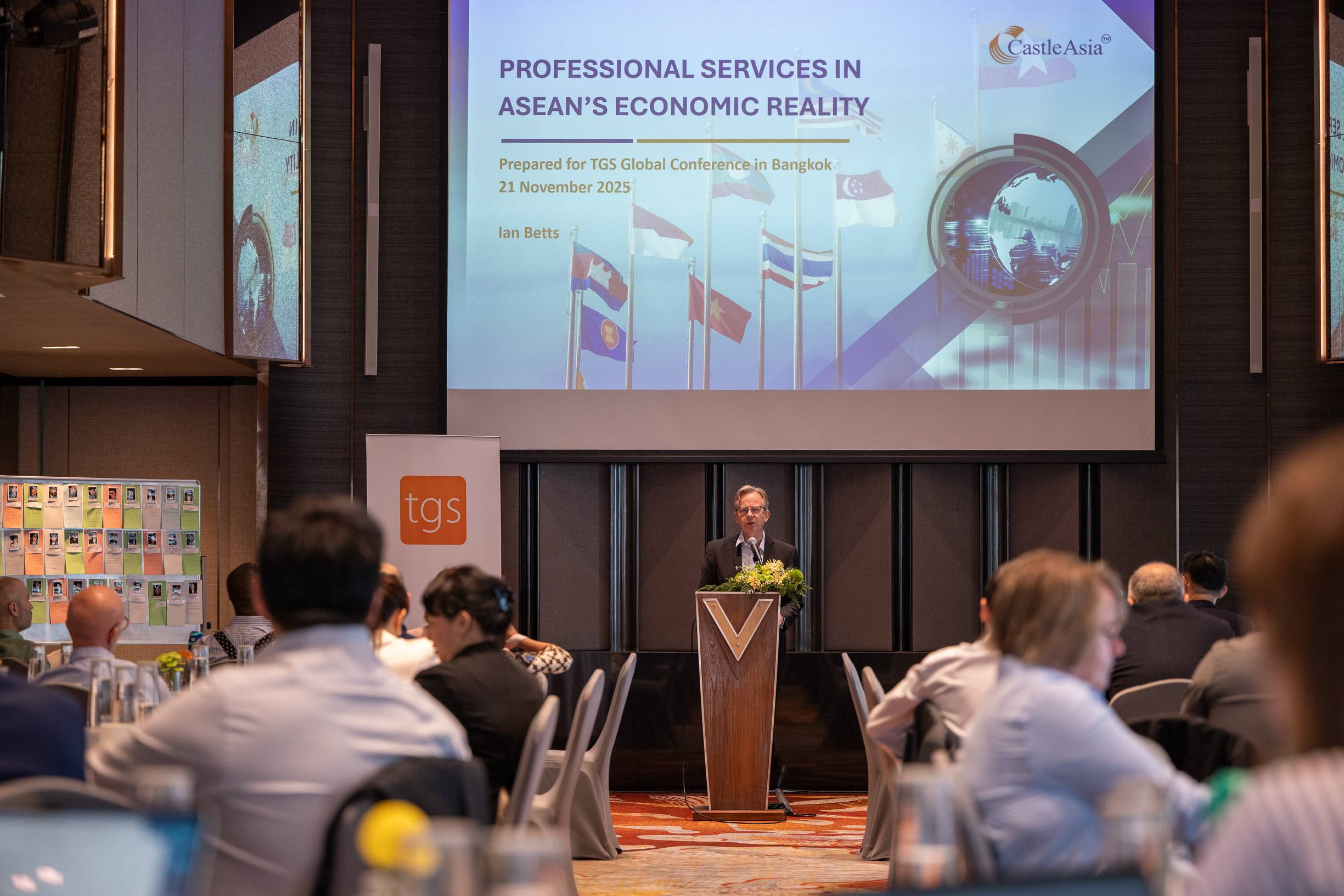
During the TGS Regional APAC 2025 Conference last June, Ian Betts of CastleAsia delivered a sharp and comprehensive briefing on the Asia Pacific macroeconomic landscape. The conversation continued at the TGS Global 2025 Conference in Bangkok, where he shifted the focus toward ASEAN: its growth dynamics, risks, and the changing role of professional services in the region.
In this Q&A recap with Mikail Jaman, managing partner of TGS AU Partners and director of TGS Global APAC region, we explore the key insights drawn from his presentation, “Professional Services in ASEAN’s Economic Reality.”
Q: How would you describe APAC’s economic outlook for 2025–2026?
If you asked me directly, I’d say the region is entering a period of steady but cautious growth, supported by strong domestic demand and accelerating supply-chain shifts especially in the Southeast Asia region.
APAC’s GDP is expected to be around 4%, while ASEAN itself is projected to grow slightly faster at about 4.5–5.0%, driven by large, young, and increasingly urbanized populations, especially in Indonesia, Vietnam, and the Philippines.
With the demographic condition driving the economic growth, Indonesia currently has roughly 287 million people, Vietnam about 102 million, and the Philippines around 118 million. The countries together represent a massive demographic engine that can sustain long-term consumption, labor supply, and market expansion.
Those factors make the South East Asia region as the most compelling investment destinations over the next decade.
Q: What do you think is driving this growth across APAC, especially ASEAN?
From my perspective, the momentum comes from rising household consumption due to the large population and rapid digital and green transformation within ASEAN, supported by global manufacturing gradually shifting into Southeast Asia.
At the same time, the broader APAC region benefits from India’s strong investment-led expansion, which helps balance some of the slowdown coming from China.
Additionally the China+1 global supply chain approach as a response to trade tariff policy affecting the shift of FDI moving to ASEAN countries, like Vietnam, Malaysia or Indonesia. This situation also makes the growth in the region.
When you put these factors together, the growth outlook feels optimistic but still grounded in real structural shifts happening across the region.
Q: Given those growth drivers, which sectors in ASEAN stand to benefit the most?
The public sector is accelerating reforms, creating more room for companies to become the providers or partners in governance, digitalization, and infrastructure modernization.
Family-owned and mid-market firms, on the other hand, are seeking more professionalization as they scale.
FDI in the manufacturing sector also continues moving into Southeast Asia.
Beyond that, the strongest momentum is in emerging sectors like renewables, logistics, and healthcare. All of which are expanding rapidly, especially for companies that are ready to operate within ESG frameworks as sustainability expectations are increasing across the region.
Q: And what risks or uncertainties should we be aware of?
If you and I were discussing this over coffee, I’d tell you that ASEAN is still exposed to external shocks from U.S. and China tensions.
Factors such as trade tariff policy, China’s slowdown, climate risks and volatile capital flows, together, all these challenges can quickly affect both trade and investment sentiment across the region.
Q: If I were a multinational company eyeing expansion into ASEAN, what information should I gather?
With regard to expanding into ASEAN countries, each has different strengths which could be one or more of these aspects: market size, risk of policy and political stability, human capital productivity and trade partners, including minimum size of investment, regulatory, or local partnership requirements.
With regional growth trends and regulatory realities in mind, ASEAN remains a region with highly promising long-term prospects, where each ASEAN country offers different advantages for the sectors prioritized by the respective countries.
Sectors such as high tech, EV auto manufacturing and digital services are among the primary sectors for FDI, but many other sectors are also promising.
When it comes to FDI or setting up the company, conditions can vary significantly for each country. For instance, Indonesia and Philippines had for many years FDI policies that were open to what we consider to be large size investments or high density capital projects, which might be a downside for small or mid size foreign companies.But those countries offer the biggest and most productive populations, and are relaxing some sectors for entry by foreign investors.
Meanwhile, a country like Thailand offers advantage to small and medium size companies since it does not require the investment threshold magnitude required by Indonesia or the Philippines. The domestic market is smaller than that in those two countries, and in some sectors remains restricted, which limits foreign ownership or participation in certain industries.
So, while Thailand may offer attractiveness in sectors like high-tech, EV supply chain, or data centers, market entry requires careful legal structuring and compliance.
About Ian Betts
Ian Betts is Chair of the British Chamber of Commerce in Indonesia (“BritCham”) and APAC President of the Institute of Security Risk Management (ISRM).
Ian now leads the CastleAsia flagship Indonesia Country Program (“ICP”), a business intelligence, strategic advisory and knowledge platform comprising a broad membership of multinational and Indonesian corporations and companies, multilateral institutions, embassies, trade missions, delegations and other bodies.
News & Articles Recommendations.